
OCI containers
Any OCI image, run under Podman as a Quadlet and kept to its desired state.
Built in Rust · by Mainsail Industries
littlestar is the immutable, signed operating system for core to edge machines. No SSH, no shell, no inbound ports. You run it on your hardware and manage it through one API.
The OS under Starlight. Every Starlight node runs littlestar. Meet Starlight →
What it runs
Any OCI image, run under Podman as a Quadlet and kept to its desired state.

libkrun microVMs through crun for workloads that need their own kernel.

Isolated clusters, each node its own microVM, with replicated storage via littlestar-x.

llama.cpp, vLLM or mistral.rs, served on the node with GPUs passed in through CDI.

Edge agents and MCP tools over NATS, every call authorised by Cedar policy.
Platform
A minimal, immutable bootc image built from source. Boots only a signed kernel under Secure Boot.
Rust services that hold the fleet's desired state and record why every workload runs where it does.
A Rust service on every node. Pulls desired state over NATS, applies it with Quadlets and bootc, reports back.
Every node is reachable by its key over QUIC, through any NAT or firewall, without opening a single inbound port.
Connectivity
iroh connects every machine over QUIC by its key, not its IP, through carrier NAT and firewalls you don't control, falling back to your own relays. The hub reaches any node, any node reaches the hub, and not one inbound port is opened. Each node also runs a NATS leaf, so it keeps working through an outage and catches up exactly once.
No shell. Just the API.
There's no SSH and no shell, so there's nothing to log into. Every node, app and update is managed through one authenticated API. Root is locked, and the kernel is signed end to end, so only verified code ever runs.
Kernel security
Kernel Self Protection Project settings, checked every build
Control-flow integrity, zeroed stacks, full struct randomisation
Even root can't change the running kernel
MODULE_SIG_FORCE: unsigned modules are refused
Direct to the node
Point lsctl at a node's key and iroh does the rest: a quick handshake through your relay, then a hole-punched, end-to-end encrypted QUIC path straight to the machine. Logs, status and Machine control, with no VPN, no bastion and no SSH.
$ lsctl --node 7f3a…c21e status
connected · direct · 18 ms
os v42 · 3/3 apps Ready
Machine API
Ship apps, AI models and OS updates to every site from one place. Roll changes out in stages, watch them land in real time, and roll back automatically if anything looks wrong. Your team stops traveling to sites and starts shipping faster, with fewer outages.
$ lsctl apply -f - <<'EOF'
kind: App
metadata: { name: thermal-cam }
spec:
  image: zot.hub/cams/thermal@sha256:9c1e…
  quadlet: thermal-cam.container
  rollout: { batch: 10%, healthGate: Ready, autoRollback: true }
EOF
app/thermal-cam configured ✓

$ lsctl why thermal-cam --node yard-07
Agreement ag-31f2  state=running
  policy: site-has-camera  ✓ permit
  policy: gpu-not-required ✓ permit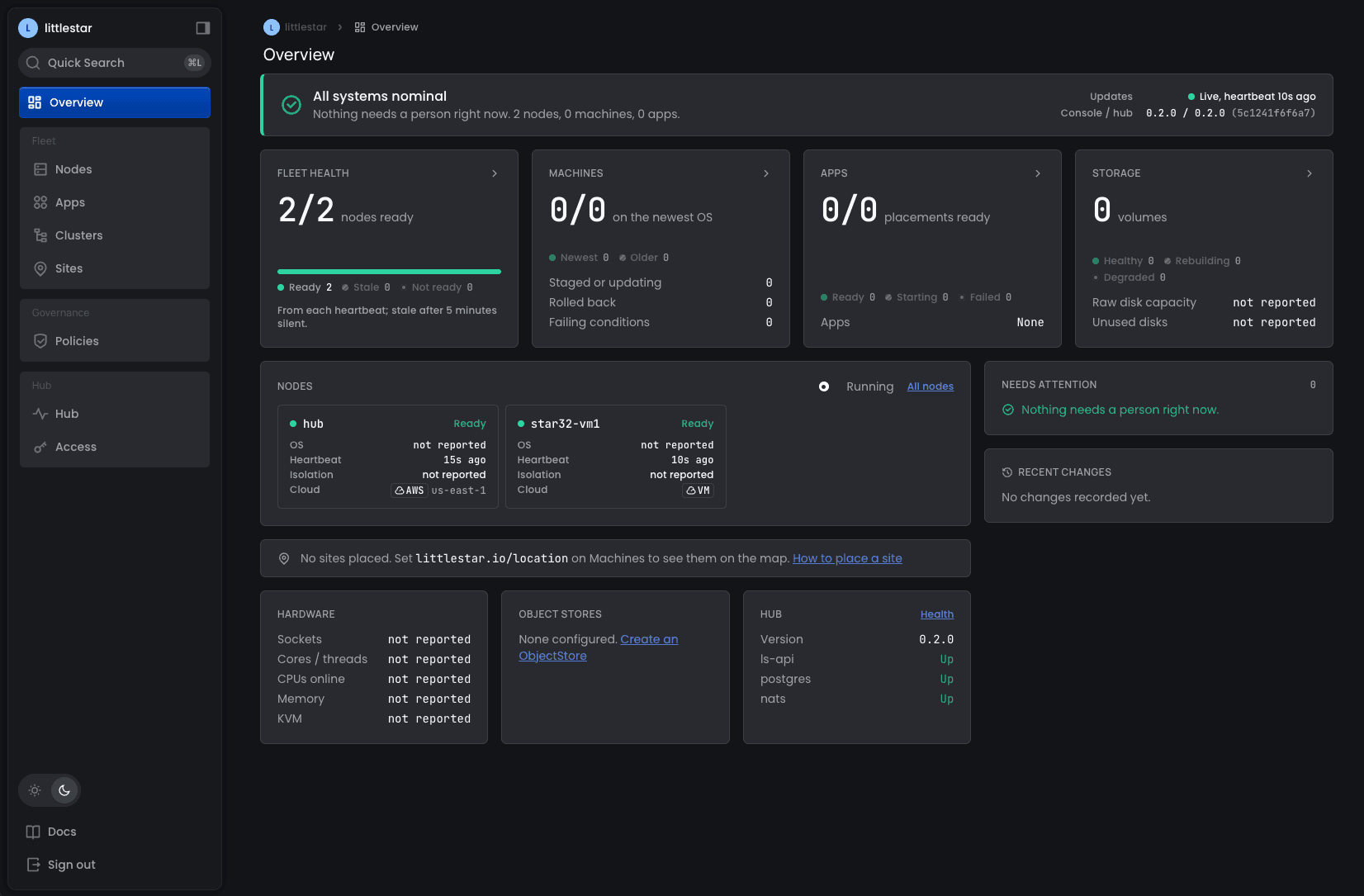
health gate failed? → back to v41 automatically, no truck roll.
Updates
Apps ship in batches behind health gates. OS images stage as one deployment, apply with one reboot in the maintenance window, and return to the previous image if the health gate fails.
Security

Every package compiled from upstream source by a toolchain that rebuilds itself. Rust where it matters: uutils coreutils, bootc, netavark, and every littlestar component.

The OS is one signed container image on a composefs root. No package manager on the node, nothing drifting, nothing to patch by hand.

Nodes dial out over QUIC and are addressed by key, not IP. Through any NAT, carrier network or firewall, with zero inbound ports and no VPN.

Root is locked, early-boot failures reboot instead of dropping to a shell, and the kernel command line can't be edited. There is nothing to log into.
Every Node, App, Model and Rollout is a resource in an OpenAPI 3.1 spec, with ETags, problem+json and live SSE watches. lsctl and the console are generated from it.

Apps roll out in batches behind health gates. New OS images stage, apply with one reboot and roll back on their own if the health check fails.

Kernel, initramfs and command line ship as one signed UKI under Secure Boot. Change one byte and it doesn't boot.

Placement is decided by Cedar policy, deny by default, and recorded as an Agreement you can query.
Source available to qualified government and critical-infrastructure partners. Read the spec and tell us what your fleet needs.